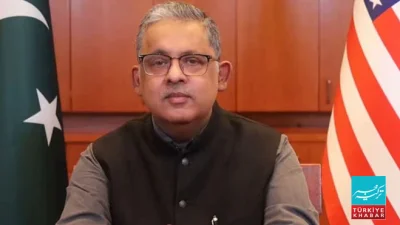
Islamabad (Turkiye Khabar) Pakistan’s Ambassador to the United States, Rizwan Saeed Sheikh, has said that after Maarka-e-Haq, Pakistan emerged not only as a strong defensive power but also as an important force for stability in the region on diplomatic and political fronts, while the country’s prestige and credibility have significantly increased within the international community.
Speaking in a special interview on the completion of one year of Maarka-e-Haq, the Pakistani envoy said that Pakistan played the role of a responsible state at every stage. According to him, after the Pahalgam incident, Islamabad immediately demanded transparent investigations; however, India resorted to unlawful aggression while making allegations without evidence.
Rizwan Saeed Sheikh stated that Pakistan continuously warned the international community that any adventurism in a nuclear-capable region could lead to dangerous consequences.
He said that despite tensions, Pakistan demonstrated political wisdom, diplomatic prudence, and military maturity, which further strengthened Pakistan’s position at the global level.
According to the Pakistani ambassador, Pakistan’s defense expenditures are lower compared to India’s, but the real strength lies in modern defense strategy, national unity, and the determination of the people.
He said that during Maarka-e-Haq, Pakistan presented its case before the world on the basis of facts, patience, and wisdom instead of emotionalism, which is why the weaknesses in the Indian narrative became evident in the era of global and social media.
Rizwan Saeed Sheikh added that Pakistan is still demanding concrete evidence regarding the Pulwama and Pahalgam incidents, and the international community is also awaiting answers to these questions.
Speaking about the Indus Waters Treaty, he clarified that there is no clause in the agreement that allows it to be suspended unilaterally.